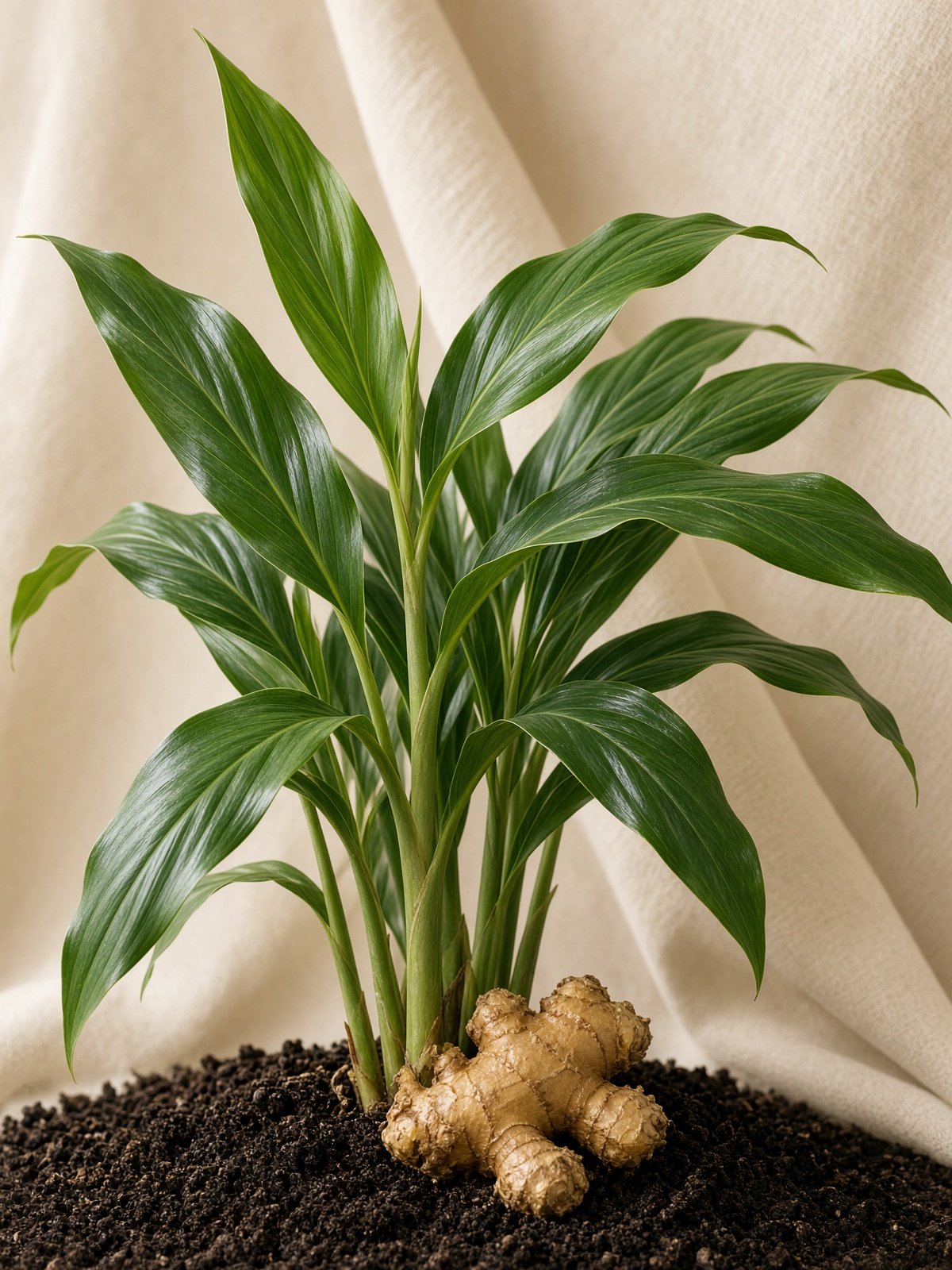

Zingiberaceae · rhizome
Ginger
Zingiber officinale
Rhizome mapped in this catalog for traditional digestive and nausea-related use. Human trial literature reports modest, heterogeneous results for several nausea settings.
Safety first
Culinary rhizome is food-like; concentrated extracts raise bleeding and gallbladder questions and are not interchangeable with kitchen ginger.
Tradition vs trials
Traditional record. Western herbalism, TCM (sheng jiang, gan jiang), and Ayurveda record the rhizome as a warming digestive and circulatory spice.
Trial literature. Cochrane and NCCIH summaries of human trials report researched ranges for nausea; effect sizes are modest and do not replace evaluation of vomiting or abdominal pain.
Practical ranges
Educational ranges — not a prescription. Culinary use is not an extract.
dried rhizome
Traditional culinary use up to about 2–4 g/day appears in Commission E / ESCOP nausea monographs
ESCOP / German Commission E — Educational range only — not a prescription. A licensed clinician individualizes product, dose, and duration.
Pregnancy, nursing, children
- Pregnancy. Culinary use is longstanding. Concentrated supplements in pregnancy belong to clinician direction; trial literature on nausea of pregnancy is not a prescription.
- Nursing. Culinary amounts are generally regarded as compatible; concentrated products lack robust lactation data.
- Children. Culinary food use is common; medicinal extract doses in infants lack adequate data.
Contraindications
- known allergy to ginger
- caution with gallstones at concentrated doses
Key interactions
- anticoagulants / antiplatelets · caution
High-dose ginger has bleeding-signal reports. Culinary amounts are generally low concern.
Used in these diagnoses
- GERD / HeartburnDigestive
- Osteoarthritis of the kneeMusculoskeletal
- Primary dysmenorrheaWomen’s Health
- Functional dyspepsiaDigestive
- Nausea (non-acute)Digestive
- PMSWomen’s Health
- Mild rheumatoid arthritis (adjunct)Immune / Rheum / Allergy
- Chronic low-grade inflammationImmune / Rheum / Allergy
- General inflammation supportOther / General
- Acute nonspecific diarrheaDigestive
- Motion sicknessNervous / Mental
- Migraine preventionNervous / Mental
- Gout flare (supportive)Musculoskeletal
- Cyclic mastalgiaWomen’s Health
- Nausea of pregnancyWomen’s Health
- Poor appetite (after workup)Other / General
- Chemotherapy-induced nausea (adjunct)Digestive
- Biliary colic / dyspepsia (adjunct)Digestive
- Vertigo (adjunct)Nervous / Mental
- Raynaud phenomenonCardiovascular
- Endometriosis (adjunct)Women’s Health
- Heavy menstrual bleeding (workup first)Women’s Health
- Gastroparesis (adjunct)Digestive
- Delayed-onset muscle sorenessMusculoskeletal
- Uterine fibroids (adjunct)Women’s Health
- Altitude illness (adjunct)Other / General