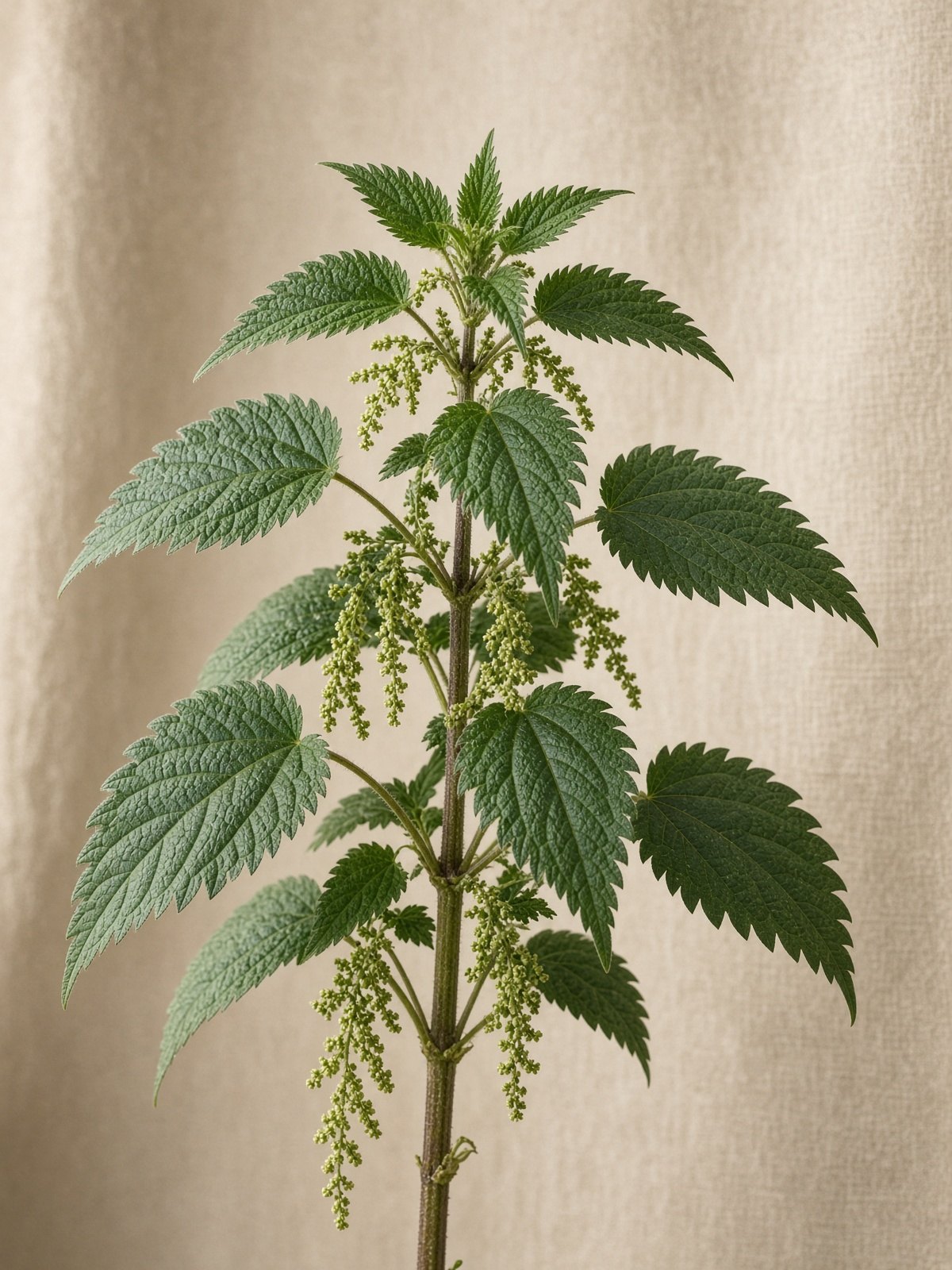
Urticaceae · leaf, root
Stinging nettle
Urtica dioica
Two official parts. Leaf mapped to human rheumatic and allergic-rhinitis-type trials; root mapped to lower-urinary-tract symptom trials in older men.
Safety first
Cooked young leaf is a food. Fresh plant stings. Leaf and root are different drugs: leaf in rheumatic/allergy-type trials, root in prostate-symptom trials. Root does not replace a urologic workup.
Tradition vs trials
Traditional record. Commission E recorded leaf as a diuretic and rheumatic supportive, and root for micturition difficulties in benign prostatic enlargement.
Trial literature. Human data exist for both parts. Effect sizes are modest; products differ. Prostate cancer still needs a clinician, not a root capsule.
Practical ranges
Educational ranges — not a prescription. Culinary use is not an extract.
leaf
Commission E-type leaf ranges are often 8–12 g/day as tea or equivalent
German Commission E / ESCOP — Educational range only — not a prescription. A licensed clinician individualizes product, dose, and duration.
root extract
Prostate-trial extracts vary; monograph native-root ranges are often several grams daily or equivalent extract
ESCOP — Educational range only — not a prescription. A licensed clinician individualizes product, dose, and duration.
Pregnancy, nursing, children
- Pregnancy. Culinary cooked leaf is food-like; medicinal root extracts lack adequate pregnancy data.
- Nursing. Culinary cooked leaf is food-like.
- Children. Culinary cooked leaf is food; medicinal extracts are not automatically pediatric.
Contraindications
- do not replace evaluation of edema, hematuria, or prostate red flags
- known nettle allergy
Key interactions
- diuretics / antihypertensives · note
Theoretical additive fluid-pressure effects with leaf.
- anticoagulants · note
Vitamin-K-rich leaf could theoretically affect warfarin stability at food-scale intakes.
Used in these diagnoses
- Allergic rhinitisRespiratory
- Mild BPH symptomsGenitourinary
- Seasonal allergiesImmune / Rheum / Allergy
- Chronic prostatitis / LUTS (adjunct)Genitourinary
- Overactive bladder (adjunct)Genitourinary
- Allergic conjunctivitis (adjunct)Immune / Rheum / Allergy
- Osteopenia (adjunct)Endocrine / Metabolic
- Telogen effluviumSkin
- Uterine fibroids (adjunct)Women’s Health