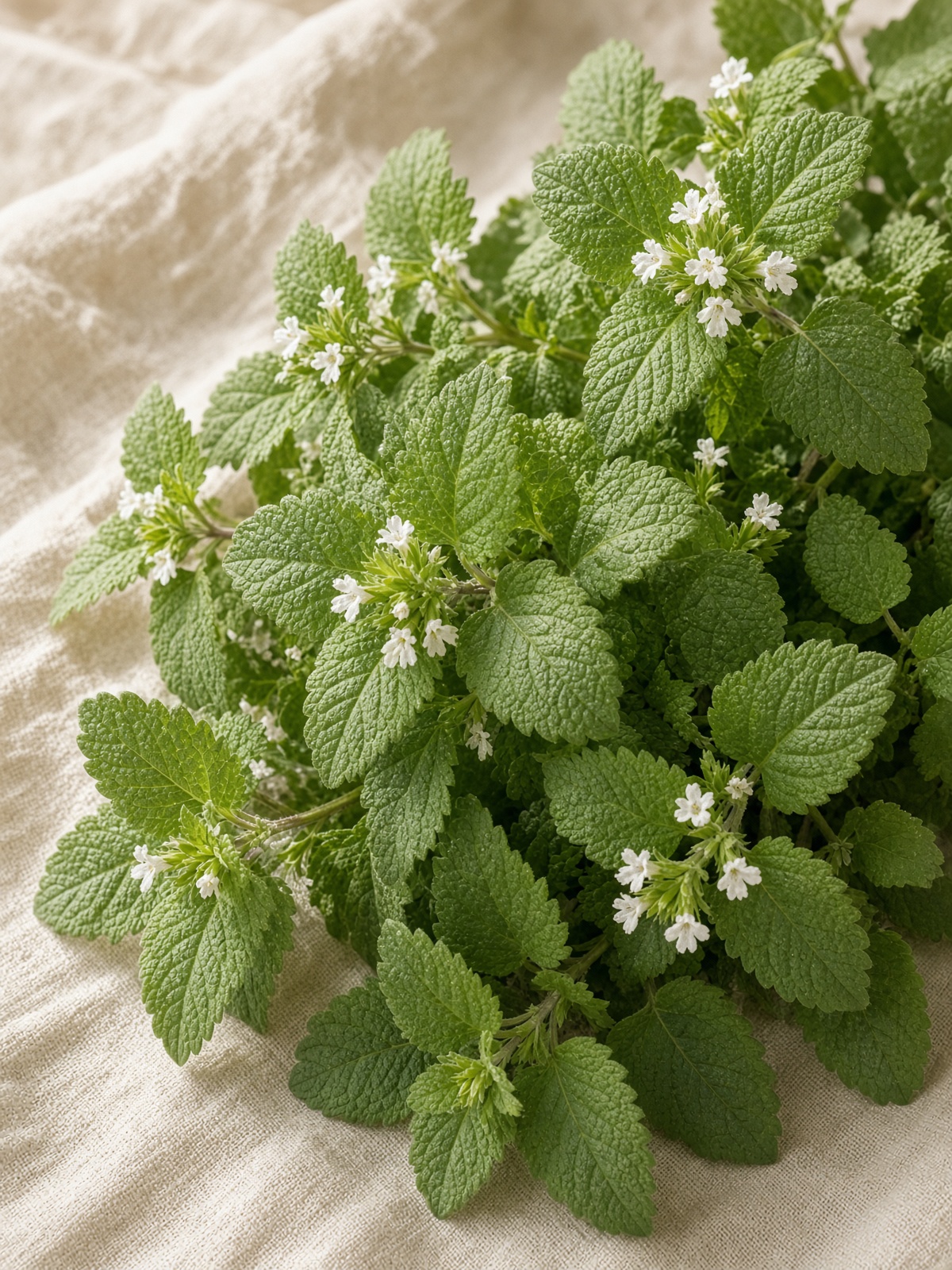
Lamiaceae · leaf
Lemon balm
Melissa officinalis
Lemon-scented leaf mapped to modest human trials for restlessness and cognitive/mood endpoints, frequently in combination products.
Safety first
Leaf tea is generally gentle. Concentrated extracts appear in small human mood and sleep trials, often combined with valerian. Theoretical thyroid caution exists; do not use concentrated products as thyroid self-care.
Tradition vs trials
Traditional record. European monastic and Commission E records use the leaf for nervous digestive complaints and mild tension.
Trial literature. Human trials include combination sleep products and small standalone mood/cognition studies. Attribution is often shared with valerian.
Practical ranges
Educational ranges — not a prescription. Culinary use is not an extract.
dried leaf
European monographs commonly list about 1.5–4.5 g leaf as tea, several times daily, or equivalent extract
ESCOP / German Commission E — Educational range only — not a prescription. A licensed clinician individualizes product, dose, and duration.
Pregnancy, nursing, children
- Pregnancy. Culinary-strength tea is traditionally used; concentrated extracts lack adequate pregnancy data.
- Nursing. Culinary-strength tea is traditionally used; concentrated extracts lack adequate lactation data.
- Children. Weak tea is a traditional European children's nervine; extracts are not automatically pediatric.
Contraindications
- known mint-family allergy
- unsupervised concentrated use in thyroid disease
Key interactions
- CNS depressants · caution
Additive sedation possible with extracts.
- thyroid hormone · note
Theoretical TSH/thyroid interference from concentrated extracts; tea is less of a concern.
Used in these diagnoses
- Mild situational anxietyNervous / Mental
- Insomnia (non-organic)Nervous / Mental
- Generalized anxiety (mild–moderate)Nervous / Mental
- Stress / burnoutNervous / Mental
- Muscle tension / myofascial painMusculoskeletal
- Benign palpitationsCardiovascular
- PMSWomen’s Health
- Stress-related physical symptomsOther / General
- Herpes labialisSkin
- Cyclic mastalgiaWomen’s Health
- Fibromyalgia (adjunct)Musculoskeletal
- Post-COVID condition (adjunct)Immune / Rheum / Allergy
- Jet lag (adjunct)Other / General
- Tinnitus (adjunct)Nervous / Mental
- Pre-operative anxietyNervous / Mental
- Shift-work sleep disruptionNervous / Mental
- TMJ / masticatory myofascial painNervous / Mental
- Postpartum mood (adjunct)Women’s Health
- Night sweats (after workup)Other / General