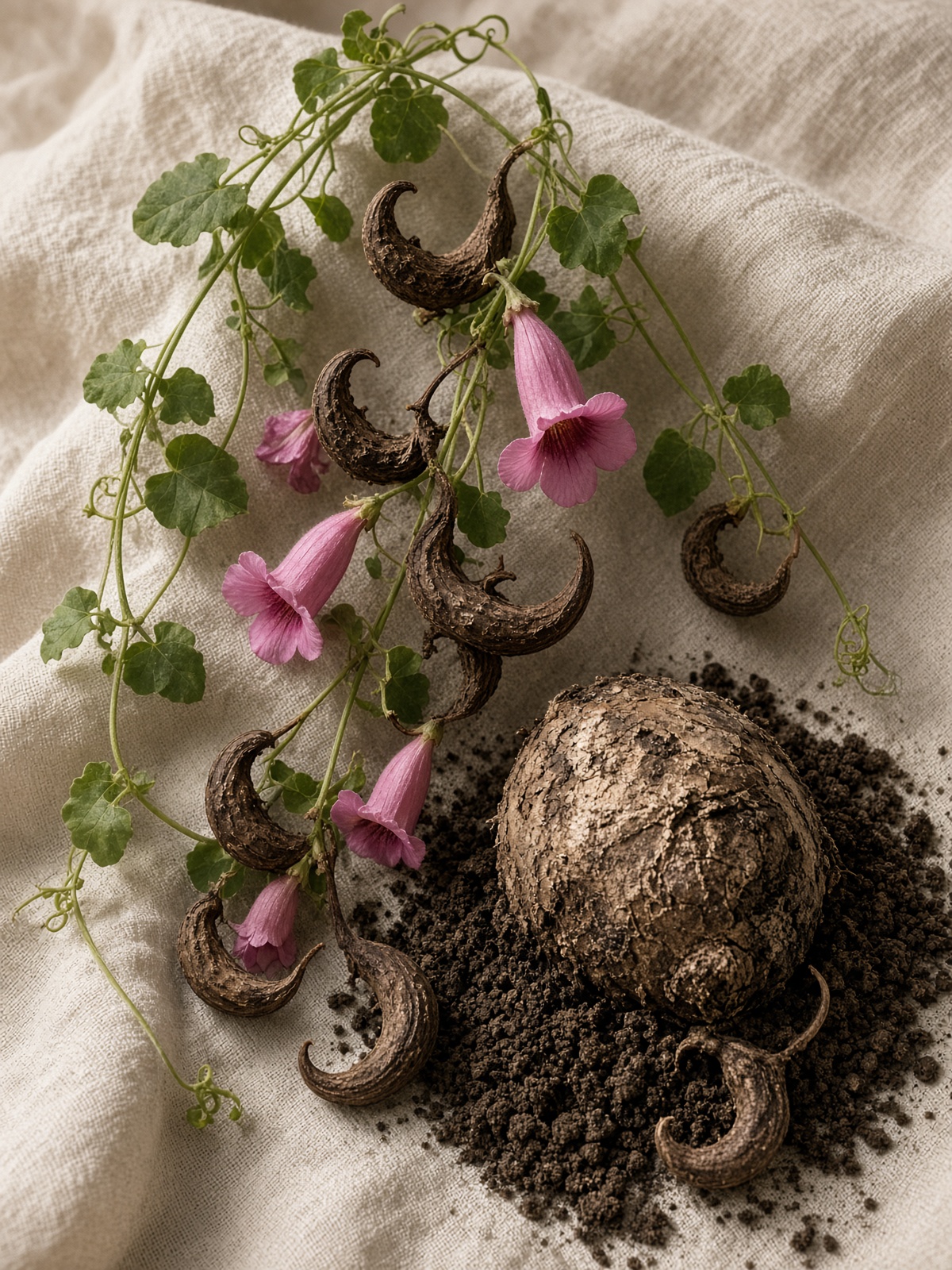
Pedaliaceae · secondary tuber
Devil's claw
Harpagophytum procumbens
Southern African tuber mapped to human musculoskeletal-pain trials of harpagoside-containing extracts.
Safety first
Bitter tuber extracts have human osteoarthritis and low-back-pain trials. Ulcer disease, gallstones, and pregnancy are monograph cautions. Wild Kalahari harvest is conservation-sensitive.
Tradition vs trials
Traditional record. Adopted into European phytotherapy; Commission E and ESCOP record it for appetite (bitter) and later for musculoskeletal pain.
Trial literature. RCTs in osteoarthritis and low-back pain report pain-scale changes with specified extracts. Not all commercial products match trial material.
Practical ranges
Educational ranges — not a prescription. Culinary use is not an extract.
dry extract
ESCOP / trial-type adult ranges often provide extracts equivalent to about 50–100 mg harpagoside daily
ESCOP / EMA HMPC — Educational range only — not a prescription. A licensed clinician individualizes product, dose, and duration.
Pregnancy, nursing, children
- Pregnancy. Avoid. European monographs advise against use in pregnancy.
- Nursing. Insufficient reliable data; avoid unless a clinician directs otherwise.
- Children. Insufficient reliable data; avoid unless a clinician directs otherwise.
Contraindications
- gastric or duodenal ulcer
- gallstones (bitter/choleretic caution)
- pregnancy
Key interactions
- anticoagulants · note
Theoretical bleeding signal; data are limited.
- acid-suppressing drugs / ulcers · caution
Bitters increase gastric secretion — ulcer caution in monographs.
Used in these diagnoses
- Osteoarthritis of the kneeMusculoskeletal
- Nonspecific low back painMusculoskeletal
- Osteoarthritis (general)Musculoskeletal
- Neck pain / cervical strainMusculoskeletal
- Neuropathic pain (adjunct)Nervous / Mental
- Sciatica (adjunct)Musculoskeletal
- Gout flare (supportive)Musculoskeletal
- TMJ / masticatory myofascial painNervous / Mental
- Lateral epicondylitisMusculoskeletal
- Carpal tunnel (adjunct)Musculoskeletal
- Statin-associated myalgia (adjunct)Musculoskeletal