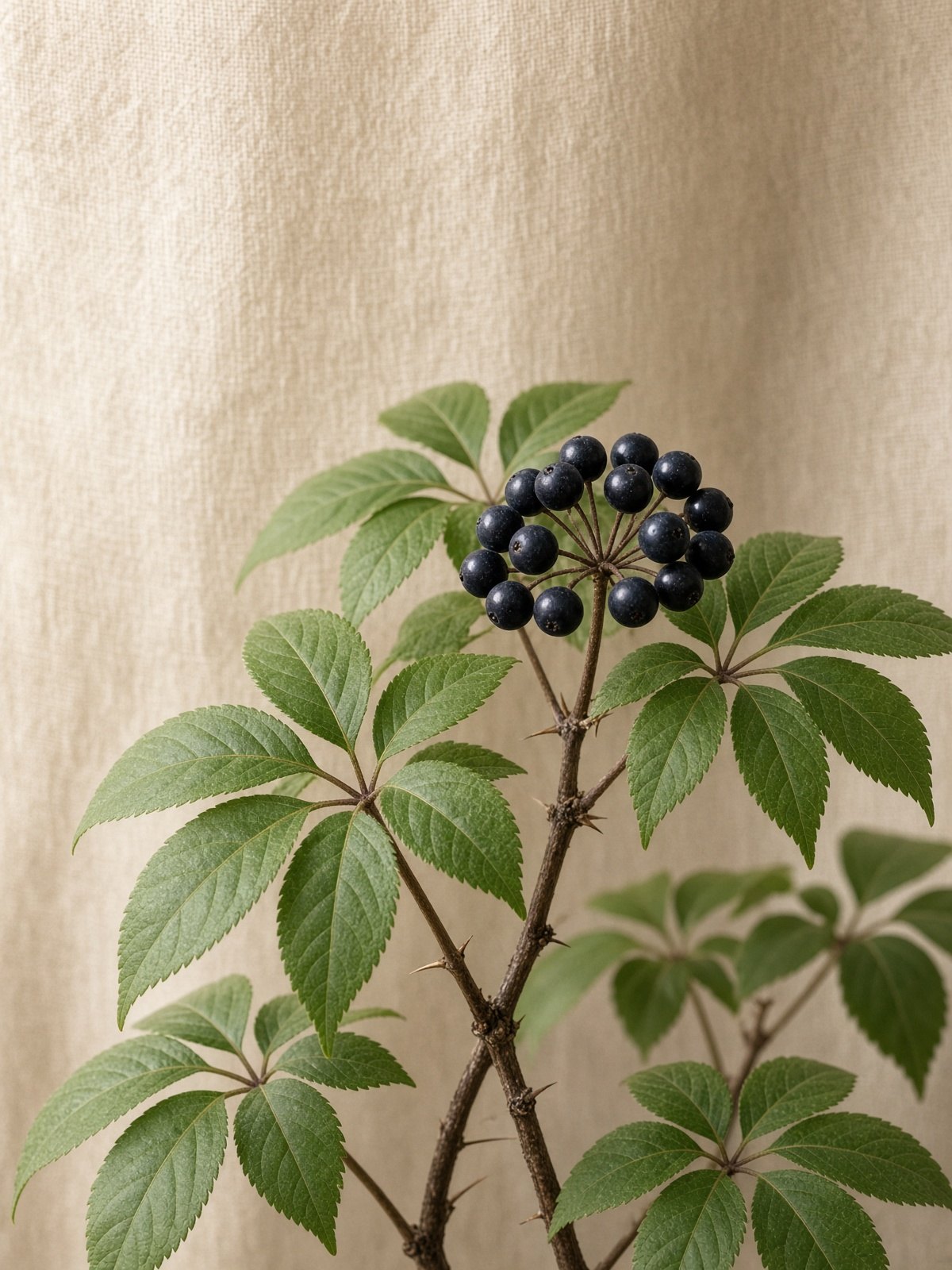
Araliaceae · root, rhizome
Siberian ginseng
Eleutherococcus senticosus
Eleuthero root mapped as a traditional adaptogen. This catalog does not upgrade sparse or poorly reported human data to a human-evidence tag.
Safety first
Not a Panax ginseng. Older Soviet adaptogen literature is hard to interpret; modern Western evidence is limited. Quality and eleutheroside assay are uneven. Can be stimulating.
Tradition vs trials
Traditional record. TCM ciwujia and later European/Russian phytotherapy use the root for weakness and fatigue. Commission E recorded it as a tonic.
Trial literature. Human trials exist but are heterogeneous, often old, and sometimes poorly characterized. EMA/ESCOP assessments are cautious. Tag remains traditional here.
Practical ranges
Educational ranges — not a prescription. Culinary use is not an extract.
dried root / extract
Commission E-type ranges were often 2–3 g root daily or equivalent extract, in courses rather than indefinitely
German Commission E / ESCOP — Educational range only — not a prescription. A licensed clinician individualizes product, dose, and duration.
Pregnancy, nursing, children
- Pregnancy. Insufficient reliable data; avoid unless a clinician directs otherwise.
- Nursing. Insufficient reliable data; avoid unless a clinician directs otherwise.
- Children. Insufficient reliable data; avoid unless a clinician directs otherwise.
Contraindications
- uncontrolled hypertension
- insomnia that worsens on the root
Key interactions
- stimulants · caution
Additive activation, insomnia, or blood-pressure rise possible.
- digoxin assays · note
Older case-level assay interference reports; interpret labs with the laboratory.