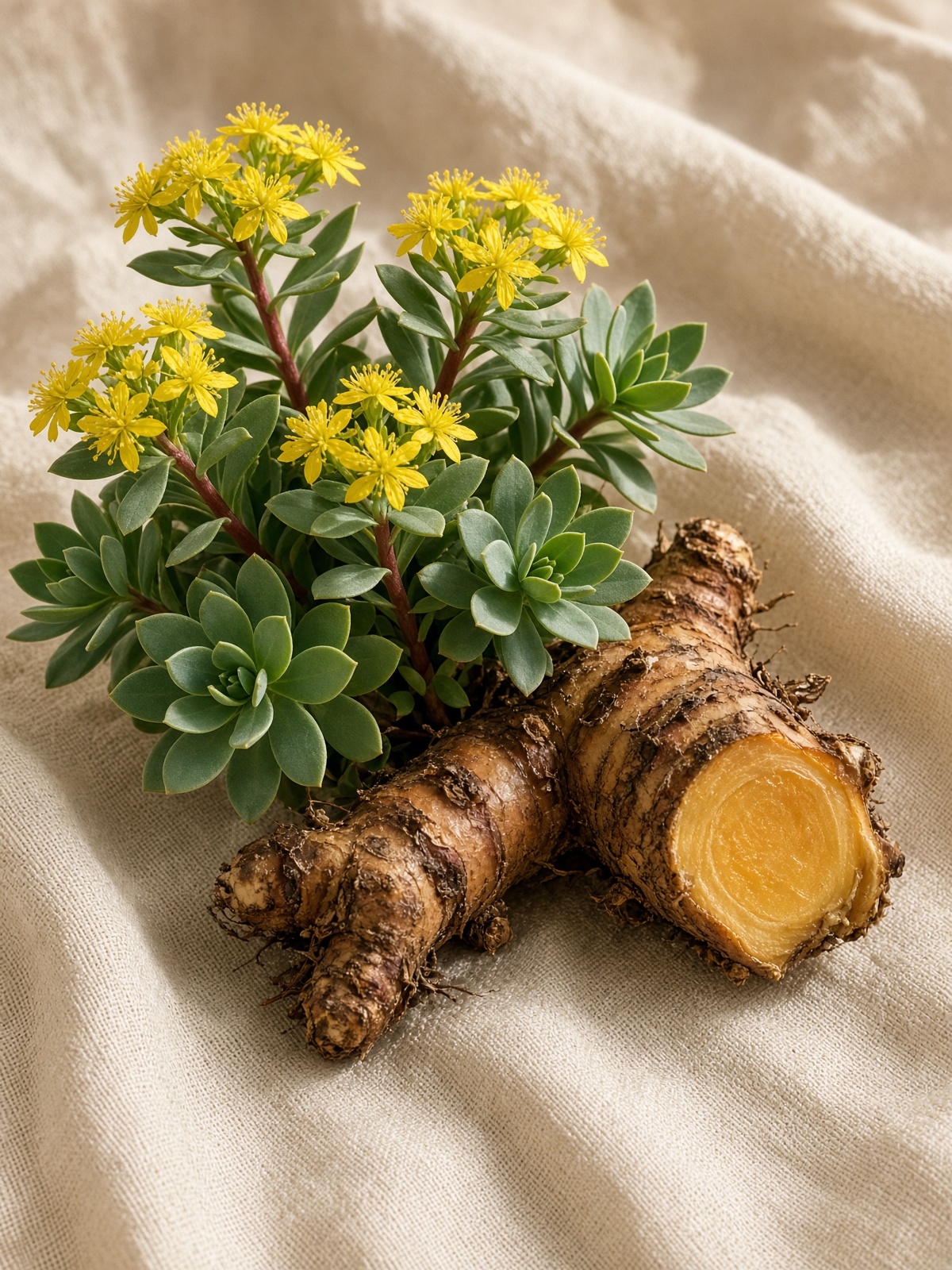
Crassulaceae · rhizome, root
Rhodiola
Rhodiola rosea
Arctic root mapped as conflicting: some small trials suggest fatigue or mood-scale changes; others do not replicate. Quality of the crude drug is uneven.
Safety first
Root extracts are marketed as adaptogens. Human fatigue and stress trials conflict, and wild-harvest pressure plus substitution with other Rhodiola species are common. Not a substitute for evaluating exhaustion.
Tradition vs trials
Traditional record. Scandinavian, Russian, and later EMA traditional-use records describe the root for weakness and fatigue after illness.
Trial literature. Human trials of SHR-5-type and other extracts are heterogeneous. EMA issued a traditional-use monograph rather than a well-established-use one.
Practical ranges
Educational ranges — not a prescription. Culinary use is not an extract.
dry extract
Trial and EMA-type adult ranges are often 200–600 mg/day of a defined extract; crude-root equivalents vary by DER
EMA HMPC — Educational range only — not a prescription. A licensed clinician individualizes product, dose, and duration.
Pregnancy, nursing, children
- Pregnancy. Insufficient reliable data; avoid unless a clinician directs otherwise.
- Nursing. Insufficient reliable data; avoid unless a clinician directs otherwise.
- Children. Insufficient reliable data; avoid unless a clinician directs otherwise.
Contraindications
- bipolar-spectrum caution (activation reports)
- known Crassulaceae allergy
Key interactions
- stimulants and MAOI-like drugs · caution
Theoretical additive stimulation; data are thin.