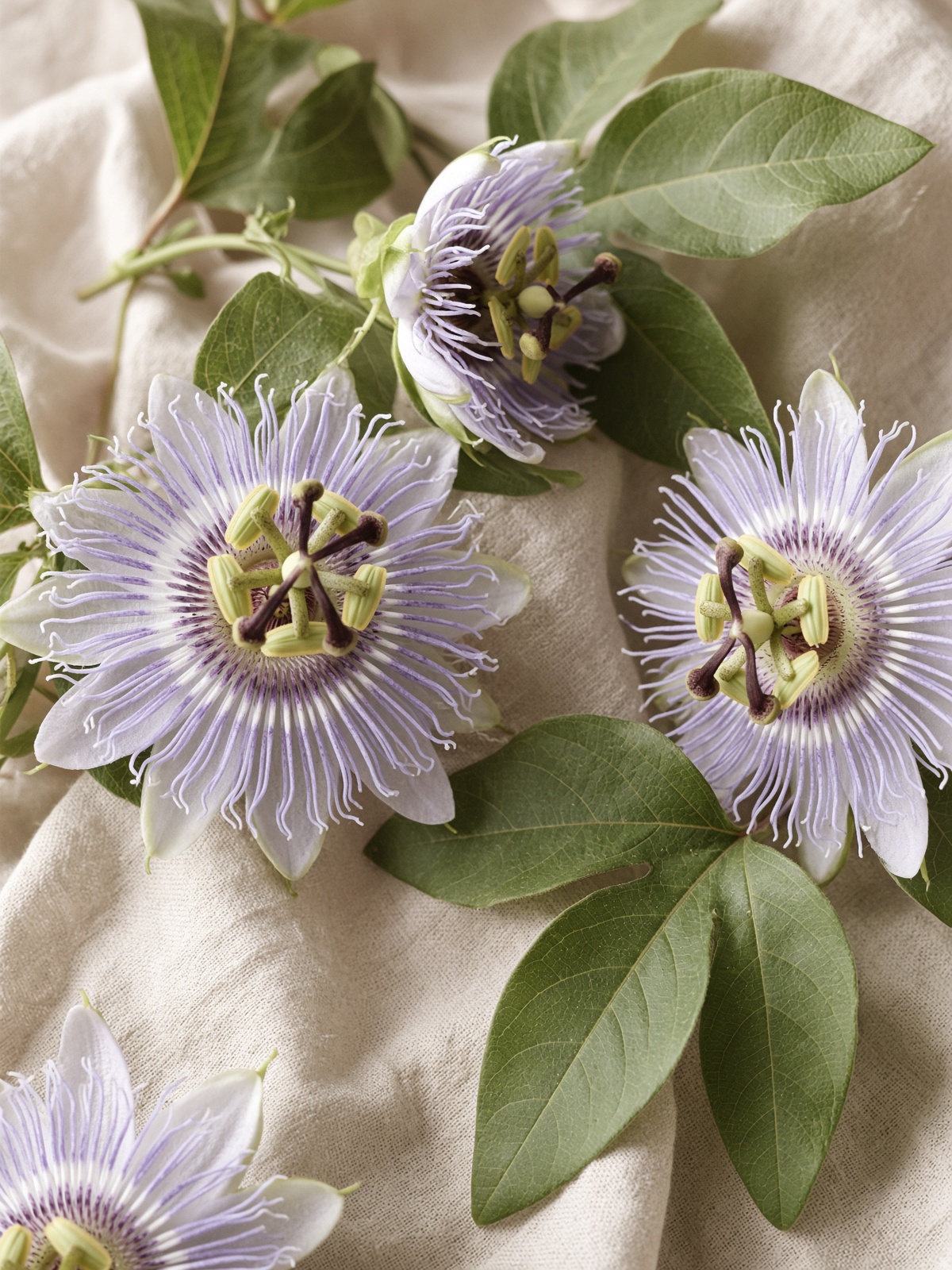
Passifloraceae · aerial parts
Passionflower
Passiflora incarnata
Herb mapped to small-to-moderate human trials for situational anxiety and as a sleep adjunct. Evidence is human-level but not large-outcome psychiatry.
Safety first
Aerial parts have modest human anxiety-related trials. Additive CNS depression with sedatives and alcohol is the main practical caution. Do not confuse with other Passiflora species sold as adulterants.
Tradition vs trials
Traditional record. North American and later European monographs record the herb for restlessness and nervous sleep disturbance.
Trial literature. Human trials (preoperative anxiety, generalized anxiety comparators, sleep combinations) exist and are generally small. EMA tags traditional use; this catalog follows the assigned human tag.
Practical ranges
Educational ranges — not a prescription. Culinary use is not an extract.
dried herb / extract
EMA-type traditional adult ranges are often 1–2 g herb as tea, two to four times daily, or equivalent extract
EMA HMPC / ESCOP — Educational range only — not a prescription. A licensed clinician individualizes product, dose, and duration.
Pregnancy, nursing, children
- Pregnancy. Insufficient reliable data; avoid unless a clinician directs otherwise.
- Nursing. Insufficient reliable data; avoid unless a clinician directs otherwise.
- Children. Insufficient reliable data; avoid unless a clinician directs otherwise.
Contraindications
- known passionflower allergy
- unsupervised combination with prescription sedatives
Key interactions
- CNS depressants and alcohol · caution
Additive sedation.