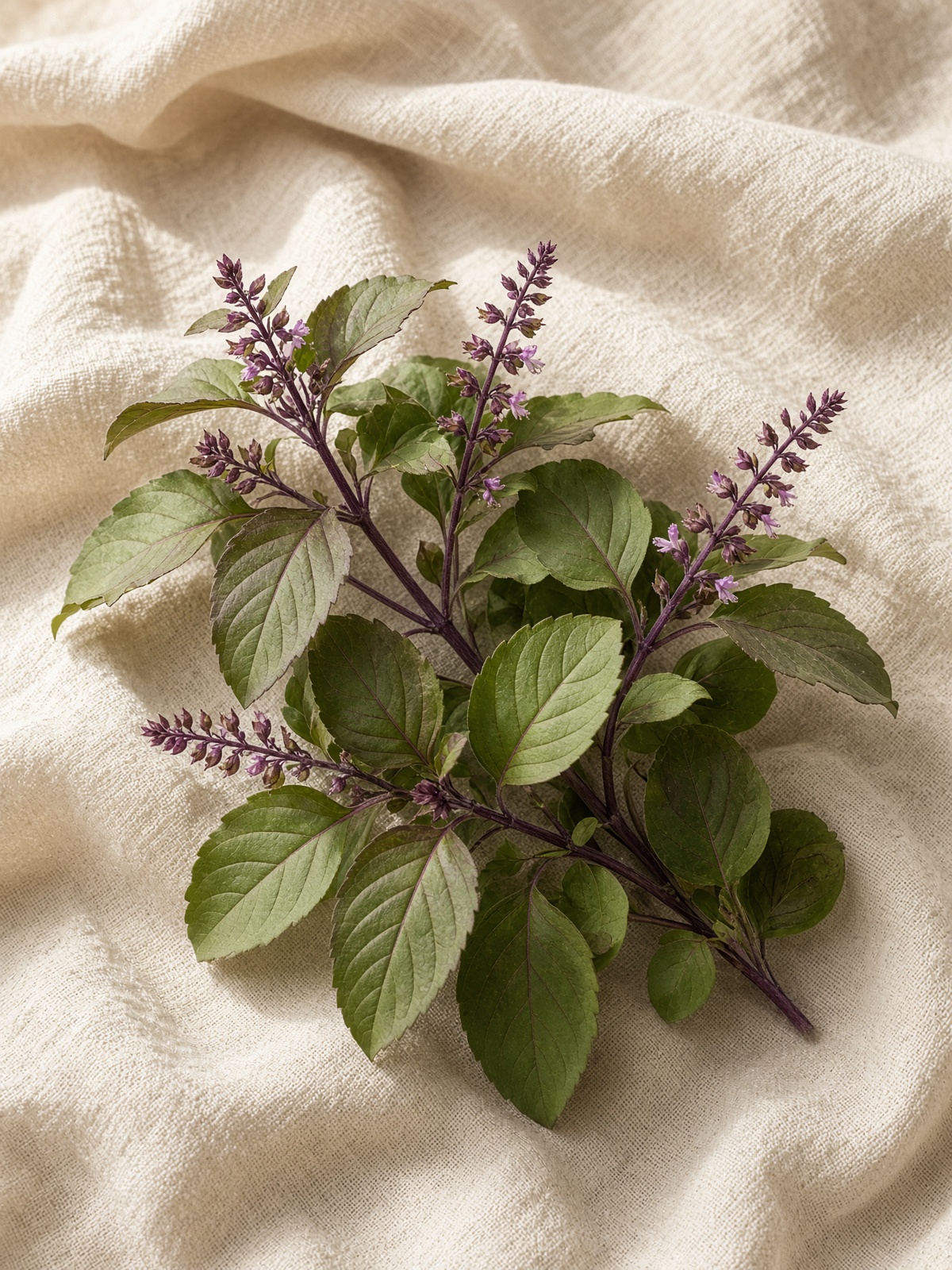
Lamiaceae · leaf, aerial parts
Tulsi
Ocimum tenuiflorum
Ayurvedic leaf mapped to small human trials for perceived stress and some metabolic markers. Rama, Krishna, and Vana chemotypes are not identical.
Safety first
Holy basil leaf tea is a common household drink in India. Concentrated extracts have small human stress and metabolic trials. Eugenol-rich chemotypes and traditional fertility cautions mean extracts are not automatically food.
Tradition vs trials
Traditional record. API and daily Hindu household use treat tulasi as a sacred rasayana and respiratory aromatic. That cultural use is tea-scale, not extract-scale.
Trial literature. Small RCTs report stress-scale and modest glucose/lipid changes. Quality is mixed; this is human-level but not large-outcome evidence.
Practical ranges
Educational ranges — not a prescription. Culinary use is not an extract.
leaf tea / extract
Household tea is several leaves per cup. Trial extracts vary (often a few hundred milligrams to a few grams of leaf equivalent). No single official range
Ayurvedic Pharmacopoeia of India (API) — Educational range only — not a prescription. A licensed clinician individualizes product, dose, and duration.
Pregnancy, nursing, children
- Pregnancy. Culinary-strength tea is widely used culturally; medicinal extracts lack adequate pregnancy data and carry traditional fertility cautions.
- Nursing. Culinary-strength tea is culturally common; extracts lack robust data.
- Children. Household tea is culturally common; extracts are not automatically pediatric.
Contraindications
- known basil/clove-type eugenol allergy
- medicinal extracts in planned pregnancy unless clinician-directed
Key interactions
- antidiabetes drugs · note
Theoretical additive glucose lowering at extract doses.
- anticoagulants · note
Eugenol has antiplatelet signals in vitro.