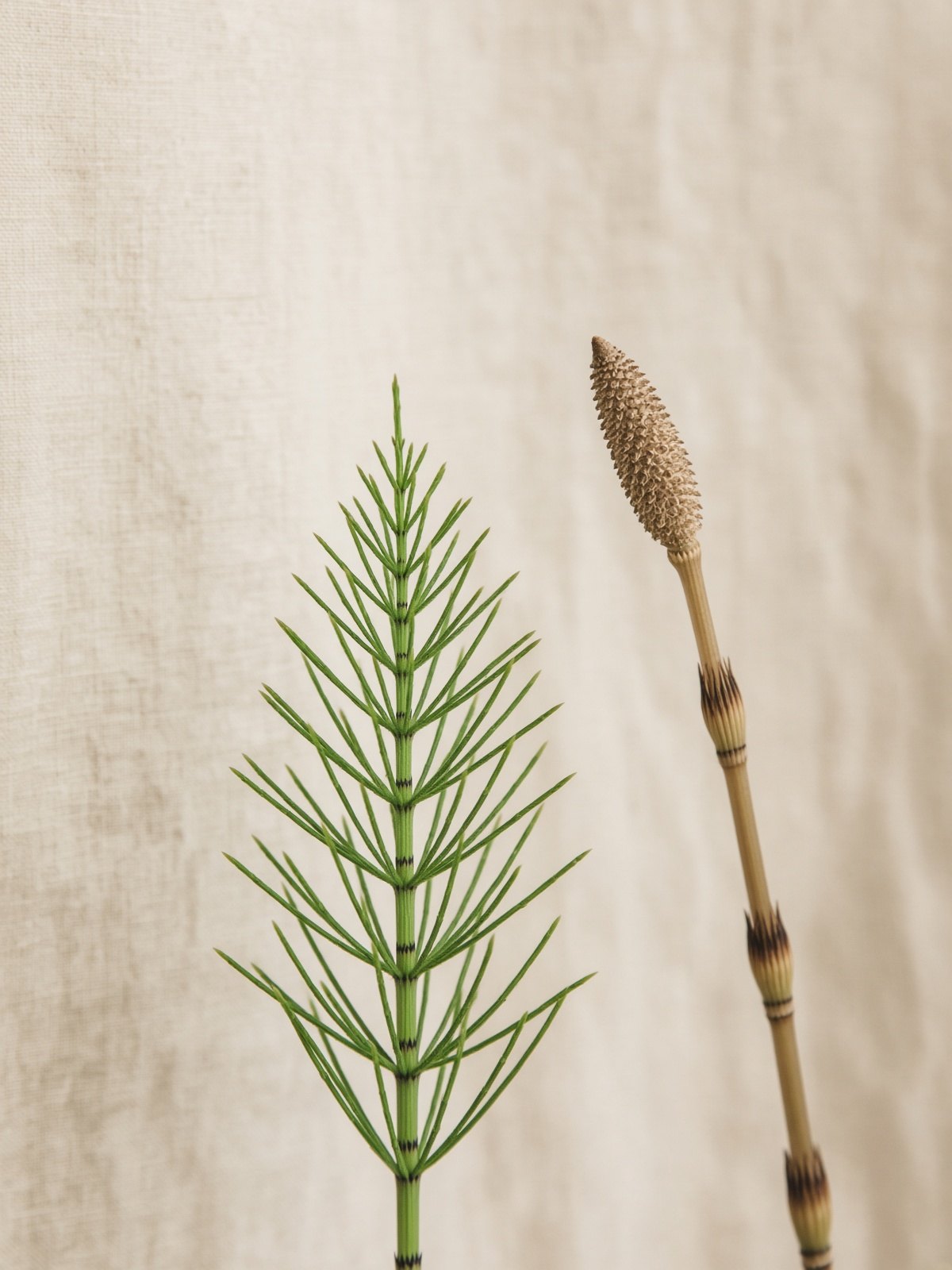
Equisetaceae · sterile stem
Field horsetail
Equisetum arvense
Traditional urinary astringent-diuretic. Mapped as a class herb next to cystitis adjuncts, not as a UTI treatment.
Safety first
Identity is the safety issue: E. palustre (marsh horsetail) contains more nicotine-like and toxic fractions. E. arvense has thiaminase activity if taken crude and long-term. Not a loop diuretic.
Tradition vs trials
Traditional record. European silica/kidney-sand folklore and Commission E diuretic records for E. arvense sterile stems.
Trial literature. Modern RCTs for UTI treatment are not the file. Traditional/monograph diuretic use dominates.
Practical ranges
Educational ranges — not a prescription. Culinary use is not an extract.
sterile stem
European monographs list traditional diuretic tea/extract ranges — short-term, identity-confirmed E. arvense only
ESCOP / EMA HMPC / German Commission E — Educational range only — not a prescription. A licensed clinician individualizes product, dose, and duration.
Pregnancy, nursing, children
- Pregnancy. Avoid unless a clinician directs a monograph product.
- Nursing. Insufficient reliable data; avoid unless a clinician directs otherwise.
- Children. Insufficient reliable data; avoid unless a clinician directs otherwise.
Contraindications
- E. palustre substitution
- edema of heart or kidney failure as a tea
- long-term crude use
Key interactions
- diuretics / lithium · caution
Additive fluid/electrolyte effects possible. Lithium handling is a clinician problem.