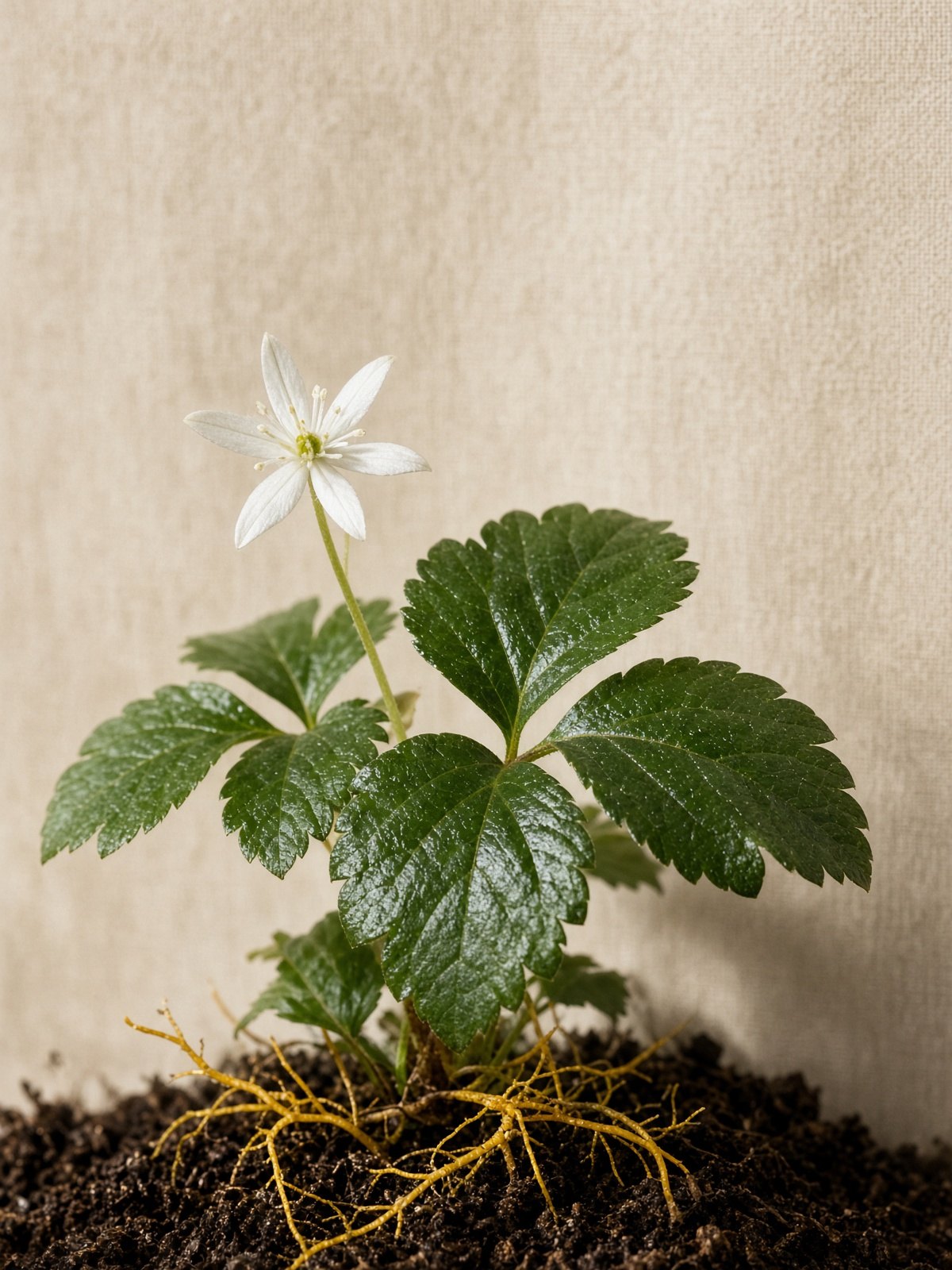
Ranunculaceae · rhizome
Chinese goldthread
Coptis chinensis
Rhizome mapped as a core TCM bitter-cold damp-heat herb. Human literature on isolated berberine (metabolic and GI endpoints) is not the same as self-prescribing the crude rhizome.
Safety first
Huang lian is a concentrated berberine crude drug, not a tea for casual use. Berberine has meaningful CYP and transporter effects, can displace bilirubin, and is inappropriate in G6PD deficiency, late pregnancy, and jaundice of newborns.
Tradition vs trials
Traditional record. Bensky and the Chinese Pharmacopoeia record huang lian for damp-heat in the stomach and intestines and for heat-toxin patterns. That is pattern language, not a Western diagnosis.
Trial literature. Human trials mainly use isolated berberine, not whole Coptis. Extrapolating those metabolic trials to crude huang lian is not valid self-care.
Practical ranges
Educational ranges — not a prescription. Culinary use is not an extract.
crude rhizome (professional TCM)
Chinese Pharmacopoeia / Bensky professional ranges are typically about 2–5 g in decoction, in formulas, not as a daily self-tea
Chinese Pharmacopoeia / Bensky — Educational range only — not a prescription. A licensed clinician individualizes product, dose, and duration.
Pregnancy, nursing, children
- Pregnancy. Avoid. Berberine can displace bilirubin and is inappropriate in pregnancy.
- Nursing. Avoid. Neonatal jaundice risk if berberine reaches a nursing infant is the core concern.
- Children. Avoid, especially in neonates and jaundiced infants.
Contraindications
- pregnancy
- nursing
- neonates / G6PD deficiency
- self-use without a clinician who can review drugs
Key interactions
- CYP3A4 / CYP2D6 / P-gp substrates · avoid
Berberine can alter levels of many drugs. Professional review is required.
- antidiabetes / antihypertensives · caution
Additive pharmacodynamic effects are possible with isolated berberine.